A Checklist for Troubleshooting Landscape Lights That Keep Failing
Landscape lighting troubleshooting starts with the power source, controls, connections, fixtures, and wiring. LandscaperBellevuewa.com uses the same fault-isolation process to identify repeat failures and explain when repair is needed.
Written by Adam Gorski · 29 years of local experience
Request an EstimateStart With the Most Likely Cause
Landscape lighting systems usually fail because power, controls, connections, fixtures, or wiring have a fault.
Start with the power source before examining individual outdoor lights. A low-voltage transformer, timer, photocell, GFCI outlet, or circuit breaker can affect the whole system.
A tripped GFCI outlet can cut power even when the breaker appears normal. Weather damage can also cause corrosion, water intrusion, loose connections, or damaged insulation.
Before You Touch the Landscape Lights
Safe observations can narrow the problem, but electrical repair requires the right training and care. Stop if you see damage, moisture, heat, or unsafe access.
Use this preparation list before checking any fixture or control.
Check the System in a Safe Order
Landscape lighting should be checked from the power source toward the failed fixtures, so each possible fault is isolated.
Our team follows the same order during a repair diagnosis. We trace the power source, lighting controls, and low-voltage transformer before checking the landscape lighting cable.
Next, we inspect wire connections and light fixtures. This method helps separate a system-wide outage from a local wiring fault, fixture problem, or voltage drop.
During the Troubleshooting Checklist
A structured check keeps small observations from becoming unsafe electrical work. You can record what you see, while our team handles testing and repairs that require technical access.
Work through the checklist in order and stop when the fault points to wiring or energized equipment.
What the Failure Pattern Tells You
The location and timing of a failure often show whether the problem affects the power source, one circuit section, a connection, or a fixture.
Failure patterns can guide the next check, but they don't replace safe testing. Our team confirms the cause before recommending repair or replacement.
| Failure pattern | Likely system area | What it may indicate |
|---|---|---|
| Whole-system outage | Power source or controls | GFCI, breaker, transformer, timer, or photocell fault |
| Single-section outage | Branch cable or connection | Loose splice, damaged cable, or failed branch |
| Flickering lights | Connection, cable, or fixture | Corrosion, movement, moisture, or unstable power |
| Dim lights | Transformer, cable, or load | Voltage drop, poor connection, or overloaded system |
| Intermittent lighting | Connection or water exposure | Moisture, corrosion, movement, or damaged insulation |
| Burned-out lamp | Fixture or lamp | Failed LED lamp, socket issue, heat, or water-damaged fixture |
When Only One Section Stops Working
One failed section usually points to a local cable, splice, connector, fixture, or branch-circuit problem.
Lighting zones often use parallel wiring, so other zones can keep working when one branch fails. Series connections can behave differently because one open connection may affect fixtures farther along the path.
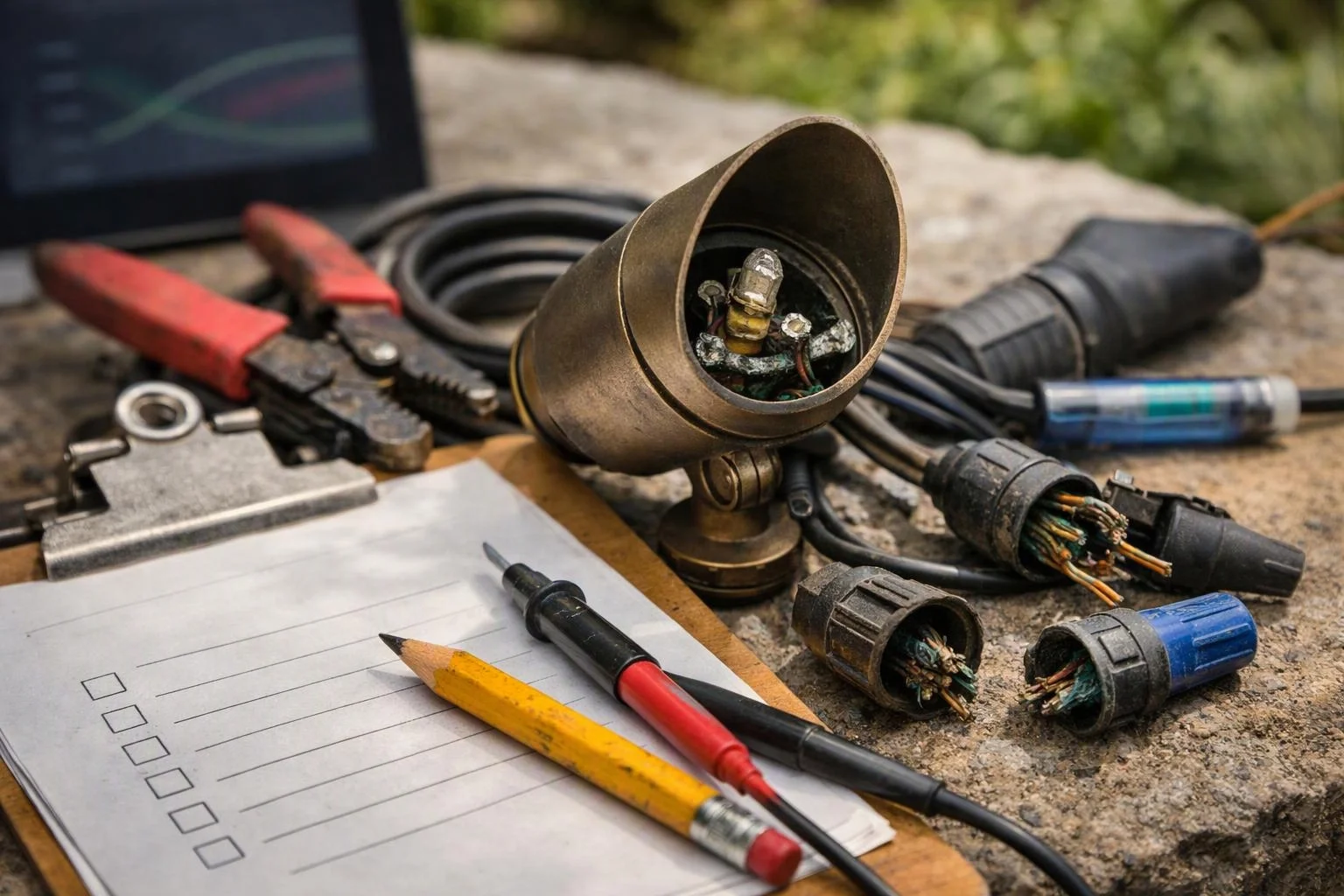
Our team checks the branch cable, wire splice, and connector for corrosion or water intrusion. We also inspect each landscape lighting fixture for socket damage and signs of moisture.
After You Locate the Fault
After a fault is located, the next step is to document the condition and choose a repair that fits the system.
Our team separates a simple connection repair from a cable, fixture, or transformer replacement. The final scope depends on access, damage, system layout, and the condition of related parts.
Red Flags That Need Professional Repair
Exposed wiring, heat damage, repeated breaker trips, and unsafe access mean you should stop troubleshooting and contact our team.
These warning signs can involve shock, fire, water, or fall hazards. Don't open damaged equipment or work from an unsafe ladder.
What to Record Before Requesting Landscape Lighting Repair
Record which lights fail, when they fail, what controls show, and any visible damage before requesting repair.
Note the affected fixtures and lighting zone first. Then record the failure pattern, transformer model, timer settings, and photocell condition.
Recent landscaping work can point to a disturbed cable or changed fixture placement. Weather exposure can point to corrosion, water intrusion, or an intermittent failure.
Clear photos of fixtures, connectors, the transformer label, and damaged areas help our team plan the repair assessment.
How We Turn Troubleshooting Into a Repair Plan
We confirm the failed part, explain the repair or replacement options, and prepare a quote based on the system's condition and scope.
Our team begins with fault diagnosis and reviews the transformer, wiring layout, fixture placement, and control settings. We then explain whether the work involves landscape lighting repair or a related installation adjustment.
Landscape Lighting Installation may be appropriate when the existing layout cannot support the desired lighting zones. We can also coordinate with a landscape lighting designer when fixture placement or system planning needs a broader review.
Our repair quote explains the expected work, access needs, replacement parts, and connection or wiring changes. For service details, see our Landscape Lighting Repair page.
Author: Adam Gorski.
Request a landscape lighting repair assessmentQuestions About Troubleshooting Landscape Lights
Why do landscape lights flicker only when it rains?
Landscape lights that flicker during rain often have moisture, corrosion, or a loose connection. Water can enter a fixture, splice, connector, or damaged cable and create an intermittent failure. Our team checks the affected zone and weather-exposed parts before recommending repair.
Can a bad transformer make outdoor lights dim?
Yes, a failing transformer can make outdoor lights dim, but cable voltage drop, poor connections, and fixture faults can cause the same symptom. Our team tests the system path before identifying the transformer as the cause.
Why do landscape lights work during the day but not at night?
Landscape lights that work during the day but not at night often have a timer setting or photocell problem. A control may be misconfigured, blocked, damaged, or receiving an incorrect signal. Our team checks the lighting controls and transformer operation.
Can new landscaping damage underground lighting wires?
Yes, new landscaping can damage underground lighting wires through digging, grading, planting, or equipment movement. Our team traces the affected branch and checks for a damaged wire, disturbed splice, or changed fixture connection.